Showing posts with label Historical Fiction. Show all posts

Thursday, June 2, 2011

Bud, Not Buddy


Title: Bud, Not Buddy
Author: Christopher Paul Curtis
Publisher and Date:Scholastic, Inc., 1999
Genre: Historical Fiction
Age Range: 6th-8th


Summary:
Bud is living in the midst of hard times. It’s 1936 and ten-year-old Bud has just “closed the door” to his old life is on a hunt for his next open door. His only clues to where this open door might be lie within a tattered suitcase; treasures cherished by his mother and collected by Bud after her death. Amid the photos and rocks lie flyers advertising Herman E. Calloway and the Dusky Devastators of the Depression. Bud hits the road in search of this mysterious man, who he believes might just be his very own father. Filled with determination, Bud is prepared to face fear, hunger, vampires, strange countryside, and even Herman E. Calloway himself in search of the truth.

Response:What an inspiring story. From the very beginning of the book I found myself cheering for Bud. His perseverance and humor are to sure keep readers of all ages engaged throughout the book. One of my favorite features of the book is Bud Caldwell’s Rules and Things for having a Funner Life and Making a Better Liar Out of Yourself. His rules and thoughts were humorous and often insightful as well. Another aspect of the book that is sure to tickle younger readers is Bud’s dialect, epically his use of the phrase “human bean.” All in all, this book is a must read, filled to the brim emotion and sprinkled with history, and topped with humor.

Teaching Ideas:This book would be a great text to include in a unit on the Great Depression. Topics for further research could include: Pullman porters, redcaps, the role of musicians during the Great Depression, and the plight of African Americans and other during this time period.
For further information check out Christopher Paul Curtis’ Afterward.
Here’s the link to a lesson plan from Read Write Think on Bud, Not Buddy:
http://www.readwritethink.org/classroom-resources/lesson-plans/press-conference-buddy-303.html

Wednesday, March 23, 2011

Rose Blanche


Title:
Rose Blanche
Author:
Roberto Innocenti and Christophe Gallaz
Illustrator:
Roberto Innocenti
Publisher:
Creative Editions, 1985
Genre:
Picture Book, Historical Fiction
Age Range:
2nd grade and up

Summary:


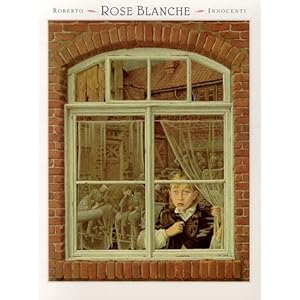
Rose Blanche is a young girl who is living in Germany during the time of WWII. Things have changed in her town; trucks rumble past carrying soldiers to unknown destinations. Rose Blanche is curious about all of these changes. One day Rose witnesses a little boy trying to escape from one of the trucks that always pass by. The young boy looked frightened; his escape was stopped by the Mayor and he was roughly returned to the truck. At this point, the story begins to change. Rose decides to follow the truck with the young boy.

What she discovers is a terrible place where men, women, and children are trapped behind a high electric, barbed wire fence. After this discovery, Rose begins conducting her own secret trips out of town to this mysterious, terrible place. Rose gives all of the food she can carry to these strangers in striped clothes wearing yellow stars. For these unknown people she is willing to sacrifice her safety and comfort, often going hungry herself.


Time passes and changes come to Rose's town again. New soldiers come and the people of the town flee. Rose Blanche, however, is nowhere to be found. Rose has gone on her mission. Rose soon discovers that town is not the only thing that has changed.


Response:

This is such a powerful, haunting book. One most powerful parts of the book is the illustrations. Innocenti tells an unwritten story through the details in his illustrations; a story that the reader must pay careful attention to as he or she turns each page of the text. The book begins with color and celebration; Rose blanch wears a red bow in her hair and proudly holds a Nazi flag. Once Rose encounters the young boy in the truck, you will notice that color in Rose's bow and in the pages of the book begins to fade. Toward the end of the text, the reader can see that Rose is no longer wearing her bow. I think this symbolizes her recognition of the Nazi party's role in these unknown people's fate and her defiance and courage to help these people. Rose's appearance also begins to change during the course of the book; her facial expressions now show sadness and worry where before she wore a smile. Rose's figure has also begun to change; she is becoming more and more gaunt as the story progresses.

The final pages of the book are again in color; the end of the darkness has come and life can begin anew. On the right hand side of the page, Innocenti includes a cross of sorts; I believe that this picture is symbolic of Rose's sacrifice.

Also, pay close attention to the narration throughout the text and you will notice that halfway through the text it switches. At the beginning of the text, Rose is our narrator (first person narration). After she discovers the camp, the narration switches to third person. This switch is important because it shifts the focus from Rose (a focus on herself) to a focus on others.

As you can see there are so many things to notice about this moving text!


Teaching Ideas:


In addition to reading the text for Rose Blanche, you MUST read the author's note that is included on the book jacket. It gives background on Innocenti's life and into the character of Rose Blanch. Did you know that Rose Blanche was named after a group of German citizens who protested the war? Eventually all of them were forced to give up their lives for their cause. You can read more about their story here.


Here are some other child friendly resources on the Holocaust.


http://library.thinkquest.org/CR0215466/the_holocaust.htm


http://library.thinkquest.org/07aug/00117/holocaust.html


http://library.thinkquest.org/05aug/00331/Camps.htm


I used Rose Blanche in connection to the novel The Guardians of Ga'Hoole: The Capture. You can check out connections between these two texts and explore the rest this unit here.

Thursday, March 10, 2011

Elijah of Buxton


Title: Elijah of Buxton
Author: Christopher Paul Curtis
Publisher: Scholastic Inc., 2007
Genre: Historical Fiction
Age Range: 3rd grade and up
Awards: Newberry Honor Book(2008)and Coretta Scott King Award(2008)

Summary: Eleven-year-old Elijah Buxton is the first free born child in Buxton, Canada, a settlement of runaway slaves just over the border from Detroit. Elijah is best known around the settlement as a “fra-gile” boy who is scared of snakes and talks to much. His other claim to fame is that he threw up on Frederick Douglass as a baby (gross, I know).

Elijah wishes that people could see him for his full potential-the best rock chunking and fish catching boy in the whole of Buxton. Elijah works hard to improve his “fra-gile” status throughout the book, and as fate would have it a rare opportunity arises in which Elijah could rid himself of his “fra-gile” title once and for all.

A former slave, the Right Reverend Zephariah W. Connerly the Third, cons Elijah’s friend, Mr. Leroy, out of all of the money he has been saving to buy his family out of slavery. Mr. Leroy “kidnaps” Elijah and takes him on a journey to the United States that will forever change his life. This poignant tale is a MUST read!

Response: Woo-wee! What a terrific book! No wonder this book was a Newberry Honor Book and Coretta Scott King Winner. Christopher Paul Curtis writes in way that will have the readers laughing along with his humor one moment and crying as the plot takes a heart wrenching twist in the next. The best word I can think of to describe this book is “inspiring,” and even that does not do it enough justice. This book opens the eyes of ALL readers to the reality of slavery. The reader experiences the horrors of slavery firsthand right along with Elijah. One of the most important and poignant aspects of the novel is that despite all of the horror experienced, Curtis manages to end the novel with a message of hope. This hope is what keeps the reader pondering and remembering long after the novel is finished.

Teaching Ideas: This would be a fantastic book to include in a unit on slavery. Just think of the important people, places, and ideas introduced in this text. From this text alone, students would be spurred to research Buxton (a REAL place-how cool is that!), the Underground Railroad, Reverend King, Frederick Douglass, and John Brown.


For other teaching ideas check out these websites:

http://www2.scholastic.com/browse/book.jsp?id=4743 (Sound to Sea does a recreation of the Underground Railroad with kids in addition to A LOT of other cool things.)

Monday, March 3, 2008

Baseball Saved Us


Title: Baseball Saved Us
Author:Mochizuki, Ken
Illustrator: Lee, Dom
Publisher and Date: Lee and Low Book, Inc., 1993
Genre: Picture book, Multicultural, Historical fiction
Age Range: 1st and up

Summary:
This book is set during WWII in the year 1942; the story takes place in a Japanese American internment camp. The story is told by a young boy who is confused and upset by what is happening to him and his family. He talks about being ostracized and called names after something called Pearl Harbor happened, and then eventually one day he and his family have to move to a new place. This new place is crowded, hot during the day and cold at night, the bathrooms and cabins have no privacy, and the traditional rules of their society no longer apply. He says that this place is a camp, but its not fun “like summer camp”. The young boy’s father decides to build a baseball field to try to reunite their family and others. They plan where the bases should be, irrigate the field, build wooden bleachers, and wear uniforms sown by their mothers. At first the young boy is scared to play baseball because he always strikes out when he bats and he plays second base (supposedly the easiest position on the field). On the day of the big game however, the young boy is up to bat with two strikes. There is a runner on second and the score is 3-2 with two outs. He says he can feel the eyes of everyone on him. He glances up to see the security guard who watches them day and night and he suddenly becomes very angry. He swings with all his might at the third pitch and hits a home run to win the game for his team! The story then skips forward in time to after the war. The Japanese Americans are no longer in interment camps, but he says life is not much better. He is made fun of at school and has no one to ea lunch with. He does however still have baseball to help him fit in. On the day of another big game, he is once again up to bat. He hears someone in the crowd call him a “jap” and he is shocked and upset that people are still doing this. He sees the glare of the sun on the pitchers sunglasses and he is suddenly reminded of the guard form camp. He swings with all his might and he hits another home run!

Response:
I really liked this book! I like that it was told through the eyes of a child; it really helps you get a new perspective on the situation. Children are so vulnerable and I think this book really conveys that. The young boy gets so upset when he is ostracized at school and called a “jap”; he cannot really understand why he is being treated differently than the other children. The explanations were heart wrenching yet simple. A child can understand what is happening to this young boy and his family easily. The illustrations also helped to add emotion to the text. They were done by applying encaustic beeswax on paper, scratching out the images, and then adding oil paint for various colors. The illustrations from the camp are all kind of blurry and brown. I think this is to help the reader picture the conditions that these people were living in, because literally in the desert the wind blew the brown sand all of everything and turned it a shade of brown. After camp however to pictures change to include more colors: green for the grass and blue for the sky. One of my favorite illustrations is on the final page of the book when all of the players form his team are holding him up to celebrate. They have put aside their differences and have united together for an instant because of their love for baseball. This picture gives me hope!

Teaching Ideas:
Baseball Saved Us would be a great book to read to first grade and up. I think children on that level and above can really appreciate what is happening to this young boy and his family. They get a real look inside Japanese American interment camps and the effects it had on the Japanese people. They can understand the racism and prejudice that this young boy suffered and they can feel his hurt as people called him names like “jap.” Students can learn to empathize with this young boy and answer questions like “What would it feel like to move away form home suddenly” “What would it be like to have no privacy?” “What would you do if someone called you a name?” These are all questions that can help children see that these things really happened, and that they happened to children just like them. It would open doors to talk to my students about prejudice, discrimination, and bullying, and what we as a class can do to fix these problems. I believe children can make a difference and I would do my best to inspire my students to do so in my classroom.

Sunday, February 24, 2008

Weedflower


Title: Weed flower
Author: Kadohata, Cynthia
Publisher and Date: Atheneum Books for Young Readers, 2006
Genre: Historical Fiction, Multicultural
Age Range: 4th-6th
Jane Adams Award
PART 1
Lonliness???

Loneliness to me can mean two things. It can mean literally having no one to talk to, play with, share things with, or even just be with. It can also mean feeling alone in the midst of having those things. It can be feeling like no one notices you, cares about you, or accepts you for who you are. Either way, loneliness is an uncomfortable, sad feeling.

What are some of your best memories? How do you hold onto them?

When I think back upon my happiest memories, I think of family and friends. I think of Christmas and Santa Claus, picnics at Crowder’s Mountain, lazy days reading on the porch swing, adopting my first cat, and my surprise sixteenth birthday party with my best friends. I hold onto these things by taking time to remember them, looking at pictures, retelling old stories, watching home videos, or just by experiencing something in my day to day life that reminds me of them.

Pre-Weedflower:

I learned so much from looking at these websites. I had always had a vague notion of what happened to the Japanese people during WWII but I never had taken an in-depth look at their side of the story. Most of these people were American born citizens who were uprooted from their lives and told that they were now enemies. The pictures from the San Francisco Evacuation presentation project broke my heart. These were our people who were forced to into relocation. Another thing that struck me is that life after the war wasn’t that much better for the Japanese Americans. The “Japanese Internment Camps and Their Effects” website specifically talked about how some could not move back into their old homes, they had trouble finding jobs, they were still shunned, and some did not ever recover form the trauma of it at all! What a big price we pay for racism!

ch.1-15

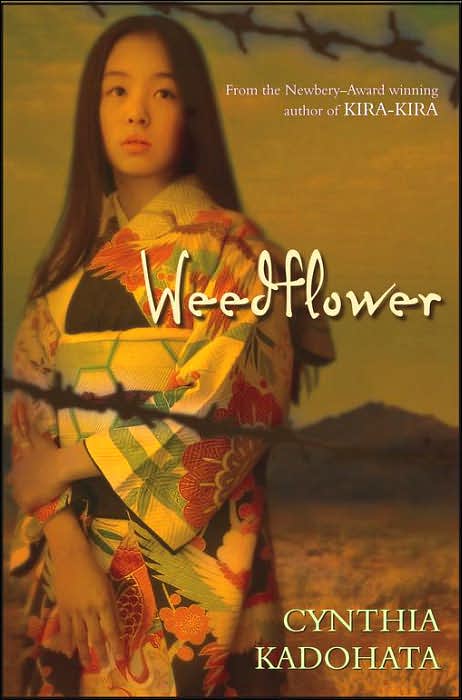
What a sad story! But at the same time what a powerful message it contains! Sumiko is the kind of character who can really make this awful situation come alive for kids. She and her family are so lovable. She loves her family, every member, and she has such a passion for their family flower business. She is not your typical child; she works hard and studies hard. I cannot imagine taking on all the responsibilities she performs as a child. She is in charge of grading the flowers, cooking, cleaning, and heating the bathwater! Tak- Tak and Jiichan are probably my two other favorite characters from the book so far. Tak-Tak is just adorable! His love of “Baba, crickets, goo and bad smells” immediately endeared him to me. He is what I would imagine a typical younger brother to be like, curious about life and protective of his older sister. Jiichan is what I would imagine any good grandfather to be like. He loves Sumiko so much; he tries to teach her the ways of their people and pass on his entire rich cultural heritage to her. Can’t you just imagine the good stories he could tell! With each line of the story you just become closer to Sumiko and her family. You grow so close to Sumiko’s character that when she is being ripped from her family, friends, and home you feel as if it’s happening to you as well.
Parts of this book made me laugh out loud! Especially when Jiichan talks to others through the outhouse doors! This is one of my favorite parts of the book so far; Bull is trying to cheer Sumiko up after her bad party experience: “She followed his gaze and saw Uncle standing in the moonlight near the outhouse, talking to it and occasionally gesturing with his arms. Whenever Sumiko saw someone talking to the outhouse, she always knew exactly where Jiichan was.” Kids will absolutely love this part of the book! Parts of the books also made me very sad. The birthday party chapter especially. I cannot imagine inviting a child to a party and then telling a CHILD that she cannot really attend because of her skin color. This is just one example of the cruelty the Japanese people were facing at this time. I was also very upset when her Uncle and Jiichan were taken away without much of a goodbye. I cannot imagine being separated from my dad, not knowing where he was going or whether or not I would ever see him again. Emotions run high in this book; I think children can appreciate that. Children always seem to sense when something is wrong even before adults do. As a teacher I would ask kids to respond to both of these situations in a journal entry. I would encourage them to talk about how they would feel if something like this happened to them.
One thing that I noticed that I found very odd was that the Japanese Americans and the Native Americans did not get along too well. I guess I expected that both could empathize with the other. They definitely did the opposite however; the Native American boys were spying on the Japanese Americans claiming that all Japanese were farmers and wasteful (pg. 121-122) and complaining that they needed to get off their land, and the Japanese American girl warned Sumiko that the Native American boys were scalpers who would also cut off their fingers to boil (pg.122). I think this is very interesting; even in the mist of experiencing racism and prejudices both groups lashed out with racism and prejudice toward each other!
There is so much more of this book to go. I cannot wait to see if Sumiko befriends the Indian boys, if their family is finally reunited, or if they reach “ultimate boredom” as Jiichan calls it. Ill guess I’ll just have to keep reading and find out!
PART 2
ch.16-33

The second half of Weedflower just flew by for me! I could not seem to put it down. One of my favorite parts early in the second half is when Jiichan sends Sumiko paper to write him a letter on. Her uncle writes, “Oh and Jiichan says to send you the enclosed blank sheet of paper. He says there must be a paper shortage in Poston, since you are using old newspapers to write on. He says I wonder where your Aunt is getting the blank paper that she writes to us on.” (pg.137) I just love this part of the book because it gives the reader a chance to laugh in such a sad book.
The Japanese gardens touched my heart. I love how Sumiko took such great care of her garden and worked so hard to get it to flourish in the middle of the desert. I think the gardens that the Japanese Americans built represent the Japanese people well. They were forced into the desert against their will yet they found ways to survive and flourish in a place where most of us would think it impossible. They worked hard and against the odds to make a place that was not even their permanent home beautiful. The line on page 235 sums this up well, "Together the Japanese had made the desert bloom." The Japanese Americans persevered and survived. This is a lesson that children and adults alike should take to heart.
One of my favorite parts in the second half of Weedflower is the relationship that forms between Sumiko and Frank. They remind me so much of Vera and Alfred in the Aleutian Sparrow. They are such unlikely friends and yet they are the best kind of friend to one another. You can tell that both of them really care about the other. Sumiko takes an extra cup of ice every time she goes out into the bean field just in case she sees Frank. Frank talks about Sumiko to his brother calling her pretty and giving her the nickname “Weedflower.” And at the end of the story Frank urges Sumiko to leave the camp because he knows that it is what is best for her. I was inwardly torn during this part. It is so hard to give a friend or a loved one up; I do not know if I would have the same courage that Frank had to tell her to go. One of the most powerful parts of the book is when Frank tells Sumiko that his brother has been killed in battle in the Pacific. Sumiko and Frank both realize that Japanese soldiers killed his brother, and Sumiko feels so guilty for this. This is just an unbelievably sad part of the book. No child should have to bear this kind of burden.
The relationship between Sumiko and Tak-Tak was also very touching. Sumiko and Tak-Tak’s relationship reminded me so much of the relationship Bo and Prosper had in The Thief Lord. Sumiko loves her brother so much and does her very best to take care of him. She always tucks him every night and removes his glasses for him to make him as comfortable as he can be.
The ending of the book slightly disappointed me; I was left craving more. What happened to Sumiko? Did she eventually get to open up her flower shop? Did the family ever get reunited? Did Bull and Ichiro make it back safely form war? This are questions that I really wanted answer to!
All in all, I would definitely use this book in my classroom. This story provides such a stark example of racism and prejudice in our great nation’s history. It gives us such an immense opportunity to discuss this with our students. Sumiko and Frank give us such a real example to build on; what if we all were as brave as Sumiko and fought for our friends and for those other people consider inferior or different. I loved it when Sumiko stood up for Frank when the other children were literally beating him because he was different. This same scenario has happened to various groups of people from the Jews, the Aleutians, and the Japanese. We need to make our students understand that these are real people whose lives were dramatically changed. None of these people did anything wrong or in any way deserved this; they simply dealt with the prejudices of their times.
Racism is such a real thing and it still exists today. Anytime that you hear a comment or joke being made about someone’s looks or heritage, that is racism in action. As future teachers we need to take the initiative to stop this kind of thing from happening in our own lives; anytime we hear a relative, friend, or even a stranger make a racist comment we need to call them out on it. People are people, regardless of their skin color, eye color, height, or age. We all share common emotions, thoughts, and experiences that bind us together. We all experience love, death, and even birthdays, we need to start focusing on what we have in common rather than we do not. This applies to our future classrooms as well. If we don’t make the everyday change in our lives and in our classrooms, than how can we expect to make a global change? And if we don’t make a global change, if we don’t stand up for others and put a stop to this senseless judging of others, than who knows what’s next.

check out these websites:
http://library.thinkquest.org/TQ0312008/http://americanhistory.si.edu/perfectunion/experience/index.html
http://www.sfmuseum.org/hist8/ppoint.html
http://pbskids.org/wayback/fair/fighters/fighters_01_1.html
http://memory.loc.gov/learn/lessons/99/fear/intro.htmlhttp://teachers.henrico.k12.va.us/specialist/franceslively/lessons/grade6/bracelet6.htm
http://www.leeandlow.com/teachers/guide1.html
http://www.pbs.org/wgbh/amex/eyesontheprize/tguide/elem.html
http://www.kimskorner4teachertalk.com/readingliterature/genres/historical/baseball_saved_us.htm
http://www.pbs.org/childofcamp/index.html
http://home.igc.org/~japa/index.html
http://www.passingposton.com/
Curicular Connections:

Monday, February 18, 2008

Aleutian Sparrow


Title: Aleutian Sparrow
Author: Hesse, Karen C.
Publisher and Date: Aladdin Paperbacks, 2005
Genre: Historical Fiction, Realistic Fiction, Multicultural
Age Range: 4th-6th


Pre-reading:
When I began to explore the websites about the Aleutian people I was overcome with an odd mixture of sadness and anger. My sadness resulted from learning about the horrible things that were done to the Aleutian people. They were first attacked by the Japanese army and then forced to relocate to an area that is comparable to a third world country. They had one suitcase of belongings, no electricity, no running water, and no hope of returning home to their previous lives (their houses and churches were burned). My anger resulted from a combination of the fact that we as American citizens never knew that this went on in our own country and the fact that this was just such an unjust thing to do! I could not imagine what it would be like to go from living your normal everyday life with all the amenities and comforts of the time, to being forced to move to a destitute place and watching all your belongings, everything you’ve worked for, disappear into the flames. It must have been heartbreaking. The Aleutian people not only suffered in material ways, but they also lost many of their friends and family because of illness. The website said that with the loss of the old they lost their history and tradition and with the loss of the young they lost their future. Somehow the Aleutian people were able to push through and survive against all odds; It makes me wonder if my family and I would be able to be so brave .


This is a quote that I think sums up the sense of loss the Aleutians suffered:"In 1942, my wife and our four children were whipped away from our home...all our possessions were left...for mother nature to destroy...I tried to pretend it really ws a dream and this could not happen to me and my dear family. "--Bill Tcheripanoff, Sr., Akutan Aleut Evacuee


After reading the Aleutian Sparrow:
Wow! What a powerful book! The reader is drawn into the fascinating world of the Aleutian people, and gets to experience the sorrow, anger, and disbelief along with the Aleutians. Our guide through this story is an amazing girl named Vera. I loved Vera; she continues to amaze me even now (days after I have finished the book). She is one of those characters whose story and plight can haunt you for a lifetime. Her attitude and positive outlook throughout the book inspired me. Vera went through so much; she was uprooted from her home, her own mother abandoned her, and her best friend (Pari) and surrogate parents (the Golodofs) died in exile. If any body had cause to despair she did; yet, through all of this Vera continues to help others. She got a job at a laundry mat to earn money, she told stories to the younger children, and she and Pari made a gigantic star to help decorate for Christmas. It makes me wonder if I could do the same if I was put into her situation.


The writing style of the Aleutian Sparrow is also very unique; I have never read anything like it. I think the brevity of the book and the diary like entries adds intensity to the book. The reader hangs on to every word Vera writes because there are so few words written. The entries are so beautifully written; they have a poetic quality that makes you just want to read them over and over again. The imagery in the passages also amazes me; one of my favorite lines is on page 58. Vera is describing the rising sun on her way to Ketchikan. She says, “My spirit rises with the sun, which parts the fingers of trees and slides its light through to the forest floor.” I think it is important to note that the brevity of the entries does not take away anything from the book; the reader still gets a full sense of the events that are occurring and their impact on the Aleutian people.


The story of the Aleutian people reminds me of two other groups of people who have also been mistreated, judged, and abandoned by the majority of their countrymen. The first group is the Jewish people. These people suffered in atrocious ways. They were ripped out their homes and communities and sent to work or “death camps”. One book from this era that particularly touched me is The Diary of Anne Frank. This book had so many similarities to the Aleutian Sparrow. Both groups of people lack medical care and amenities such as suitable bathrooms and food, Anne falls in love with Peter just as Vera falls in love with Alfred, and Anne and Vera both experience unspeakable heartaches and hardships. The second group is the African Americans. This one hits home for us. Americans mistreated these people so badly. We forced them to work for no wages, we ripped them away form their “homes” on a whim, and we often separated them from their husbands and children. The cruelty that was afflicted on them is unbelievable to me. Once again, just like in the case of the Aleutians, Americans were responsible for this.


I found two particularly sad facts in the book that I want to share. The first is that German POW’s were treated better then our own US citizens. On page 56 Vera explains that, “they are well fed…..they have cots and blankets, every last one….good sanitation and an infirmary….a variety of foods and recreation.” I cannot comprehend why we would do this for our ENEMY but not for our own people. The second is that not only did the government abandon then, their own countrymen did too. Vera talks about the people of Ketchikan and their disdain of the Aleutian people. How they want them moved away from them. One passage in particular that caught my attention is on page 124. It reads, “We are called undesirables and told we must leave Ward Lake….we are called a menace and told to leave.”


When teaching this book to children, I think it is important to stress that this story is fictional but the experience is not. This really happened to the Aleutian people. Hesse’s author note (pg. 154-155) in the final pages of her book gives a very understandable synopsis of the events that occurred between 1942 and 1945.The Aleutian websites are also good way to teach this topic. The documentary mentioned in the http://www.aleutstory.tv/ website would be a great way to show children a visual representation of what happened. There are several topics I would want to address with this book. I would have them perform the exercise that we did in class last week. We listed all of our favorite things and imagined each one being taken away. It was a very powerful illustration. This would help the children to gain perspective about what it would be like to be an Aleutian. I would also have them imagine that they were the ones who were sending the Aleutians away into exile. I would want them to be able to see and talk about both sides of the story.


Like we talked in about in class last week, I think it is very important to realize that prejudice, unfairness, and abuse exists in our society. I want my future classroom to be a place where we discuss those issues and try to find ways that we as a whole will not participate in those types of things. A child CAN develop empathy for others. I am one of those few people who have had a great life so far. I have been raised in a loving home with both of my parents present, gone to private schools, and lived in the same house since birth. I have never experienced anything close to what the Aleutians did, but I can empathize with them and all children can learn to do that as well. We all are interconnected; we all have common emotions and experiences that can be the building blocks that lead us to have empathy for others.
check out these websites to learn more about the Aleutian people:

Monday, February 4, 2008


Title: MOSES: When Harriet Tubman Led Her People to Freedom
Author: Weatherford, Carole Boston
Illustrator: Nelson, Kadir
Publisher and Date: Hyperion Books for Children, 2006
Genre: Picture Book, Multicultural, Historical Fiction
Age Range: 2nd grade and up
2006 Caldecott Honor Book
2006 Coretta Scott King Award Winner


Summary:
This book tells the amazing story of Harriet Tubman and her journey to freedom. Harriet Tubman was born into slavery, but later in her life she felt God's call for her to escape. She heeded His call and trusted Him for every part of her journey. She finally made it Philadelphia after a long hard journey. She used her time there to learn about the Underground Railroad and to help runaway slaves. She was happy to be free, but she still felt a burden for her enslaved family and friends. She felt God calling her to be a "MOSES" for her people. Harriet Tubman agreed and made nineteen trips back and forth from the North to the South rescuing slaves and through it all she gave glory to God.


Response:
I LOVED this book! Every time I read a story about slavery, it saddens and amazes. Harriet Tubman was such an amazing person. She had a strong faith in God and He helped her to do things that many people thought were impossible. This book absolutely captivated me. The story and the illustrations are so powerful. I thought it was really neat that author used three different types of text throughout the story; she used one for the narrator, one for Harriet, and one for God. When God spoke the text was large and seemed to float across the page. I think this was a great touch, because God was her refuge, her bigger than life protector, who she could not see but who she felt was with her every step of her journey.


The words of the story were powerful themselves but the illustrations added intensity to the book. The reader could see, feel, hear, and touch everything that Harriet Tubman experienced through these illustrations. The illustrations were beautifully painted double page spreads that seemed endless. The words and the illustrations meshed so perfectly together. One of my favorite pictures in the book is the on the last page of the book. The picture is simply of Harriet Tubman with a bright blue background. She looks so content and strong; the text simply reads, "Well done, Moses, well done." Harriet lived her life with courage and faith that was both astounding and inspiring. The amazing story and the breathtaking illustrations combine to make this book worthy of many honors.


Teaching Ideas:
This book is a great introduction to the topic of slavery. Not only does it tell the amazing story of Harriet Tubman but also includes other important aspects of slave culture with songs such as "swing low sweet chariot" and the mention of the Underground Railroad. This book could be combined with other great books about slavery such as picture books, novels, and non fiction books. Some great examples of these books are Sweet Clara and the Freedom Quilt, The Slave Dancer, and One More River to Cross: An African American Photograph Album. These great books could be used along with Moses: When Harriet Tubman Led Her People to Freedom to compare and contrast the stories and mediums used to tell the stories.