Saturday, April 19, 2008

Al Capone Does My Shirts


Title: Al Capone Does My Shirts
Author: Choldenko, Gennifer
Publisher and Date: G.P Putnam’s Sons, 2004
Genre: Realistic Fiction
Age Range: 4th-6th
2005 Newberry Honor Book

Summary:
This book is set during the 1930’s on Alcatraz Island off the coast of San Francisco. It tells the story of Moose, his family, and his friends. Moose is a young boy
who has just been uprooted from his home in San Francisco and moved to the isolated prison site of Alcatraz Island all for the sake of his sister Natalie. Natalie is “different” from other kids her age; she loves buttons, book indexes, and lemon cake. She has trouble functioning at a level normal for most sixteen year olds. Moose’s mother tries so hard to do what’s best for Natalie, often leaving Moose’s best interest out of her decisions. When the family moves to a “twelve-acre rock covered with cement, topped with bird turd, and surrounded by water” all so Natalie can attend the Ester P. Marinoff School, Moose has had just about enough. Not wanting to disappoint his father, Moose tries to make the best of his situation. He ends up becoming surprisingly fond of his new home. He joins a school baseball team, actually befriends Natalie, and becomes part of one of his new friend Piper’s schemes (must to his dislike). He is beginning to finally feel like he belongs. When his mother’s plan to sneak Natalie into Ester P. Marinoff School as a ten-year-old fails, Moose may face being uprooted again. He and his new friend Piper come up with a crazy scheme to sneak the infamous Al Capone ( who is a prisoner on Alcatraz) a letter asking for help. Natalie gets accepted to a new older branch of the school and Moose gets a piece of paper in his shirt with the word “done” on it. It is a great ending to a truly inspirational book!


Response:
This was such a wonderful book! It has a great setting, memorable characters, and an excellent message. The setting of the book will draw students in and fill their imaginations with visions of criminals, jail breaks, and undercover operations. The book gives just enough information about the criminals on the island to set the scene without distracting the reader from the message of the book. The map on the first few pages of the book is vital to understanding the story; be sure to take time to look at it. The characters are very true to life. You can feel Moose’s frustration with Natalie when he shouts at her, saying, “Do you have any idea what you’re doing to us? To Mom and Dad? You’re making them old. They worry about you all the time. At least you can try. At least you can do that. Sometimes I think you don’t even try and I hate you for it, Natalie. We try so hard and you don’t. I hate you, Natalie! I do!” At one time another we have all experienced frustration with someone in our lives, whether it was a parent, a friend, or sibling. The emotions and actions of the characters in this story are so true to life; students will be able to relate to all of the characters well. Probably the most important aspects of this book are the messages it sends to students. The first message I pulled from the book is to make the best of your present circumstances. Moose was uprooted from his home, his friends, and his family (his grandmother), all so that his sister could get a better education. Moose was very upset about this in the beginning of the book, but during the course of the book there is a noticeable shift in his attitude. He begins to accept his new life and even looks for ways to embrace it. He joins a baseball team at school, goes exploring for “convict baseballs” with Natalie, and even becomes friends with all the other kids on Alcatraz Island. This message is applicable to everyone. All during our lives we are put into situations that we might not to happy about; we need to learn to do as Moose did. Any situation can look brighter if we have the attitude that we are going to embrace it and make it better. The second message that I took from the book is acceptance, specifically acceptance of people we consider “different.” During the time period in which this book was set, nobody had termed the name for autism (this is the condition that affected Natalie). They had no way to treat it or to help these children or adults prosper. People during this time weren’t very receptive of it either. When Piper initially meets Natalie, she asks if she is “retarded” or “stupid.” She also hints that she doesn’t really approve of Natalie hanging around. This is so sad. We should always accept others no matter what makes them different. Moose is great example of how a person should act. He ends up being very accepting of his sister and helps her make a lot of progress by working with her and just by hanging out with her.

Teaching Ideas:
This would be a great book to incorporate into the classroom anytime for the year, but it could specifically be used when The Great Depression is being covered. The book is set during the 1930’s right when the Great Depression is hitting the hardest. I was actually slightly disappointed that the book did not mention the Great Depression more, but it does give enough information to seg-way into a discussion on the Great Depression. This is also a great book to read with your class to encourage acceptance and empathy.

Wednesday, April 16, 2008

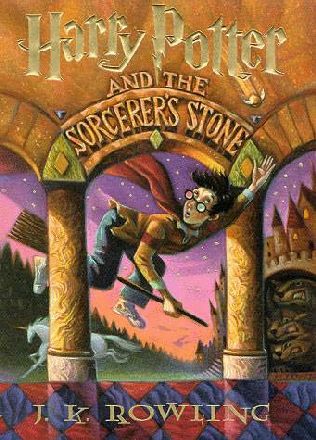
Harry Pottter and the Socerer's Stone


Title:Harry Potter and the Sorcerer's Stone
Author: J.K. Rowling
Illustrator: Mary Grandpr'e
Publisher and Date: Aurthur A. Levine Books, 1997
Genre: Fantasy
Age Range: 4th-6th grade

Summary:
Harry Potter is the loneliest, most miserable boy in the muggle (human) world. He’s shunned by his relatives, the Dursley’s, that have raised him since infancy. He’s forced to live in the cupboard under the stairs, to wear his Cousin Dudley’s hand-me-down clothes, and to go to his elderly neighbor’s house when the rest of the family is doing something fun.

On his eleventh birthday, however, Harry’s life changes forever. After much trouble and many letters, a giant named Hagrid informs Harry that he’s really a wizard and will soon be attending Hogwarts School of Witchcraft and Wizardry. Harry also learns of his fame and hero status in the wizarding world; when he was an infant, the evil Lord Voldemort killed his parents and then tried to kill Harry as well, but Harry survived and allegedly destroyed Lord Voldemort in the process!

When Harry hears the news, he is shocked and confused. Can it all be true? Everything Hagrid told him turns out to be true, and with a joyful heart Harry starts wizarding school in September. He quickly becomes best friends with a boy named Ron Weasley, and before they even make it to Christmas, they break a lot of school rules. For example, they attack a troll and prevent it from killing fellow student, Hermione Granger, while they are supposed to be fleeing to their common rooms with their fellow students. After the troll incident, the three become inseparable, and Harry is amazed to have found such great friends. He is constantly busy trying to stay on top of the mounds of homework, as well as participating in weekly Quidditch practices. Quidditch is the most popular sport among wizards and Harry is the youngest Quidditch player at Hogwarts in over a century.

As the year progresses, the three friends set out to solve the mystery of the gigantic three-headed dog that is guarding a secret in the school. They deduce that a very valuable object, the Sorcerer’s Stone, is being hidden in the school (it can lead to eternal life and abundant wealth). They began to suspect Professor Snape (one of the meanest Professors at Hogwarts) of trying to steal the stone, and they quickly take action to circumvent the theft.

Things come to a head when they sneak past the vicious, three-headed dog and go down into the bowels of the school, determined to save the stone. Ron and Hermione help Harry get through the challenges set forth to stop the thief(playing music for the three headed dog, finding the “right” flying key, winning a life size game of chess, solving a potions riddle), but Harry ends up alone to face his final challenge. He is surprised to find Professor Quirrel in the final room also searching for the Sorcerer’s Stone. Professor Quirrel is a follower of Lord Voldemort and they now share one body. Harry is forced to do battle with the Lord Voldemort, and he’s able to save the Sorcerer’s Stone, although he’s almost killed in process. The school headmaster, Dumbledore, arrives just in time to save Harry.

The school year ends spectacularly. Harry, Ron, and Hermione are honored for their bravery and service to the school, Gryffindor wins the House Cup for the first time in seven years, and Harry leaves to go back to the Dursley’s for the summer feeling as if he’s finally found a place where he truly belongs.

Response to Themes:
Harry Potter is a fantastical novel full of mystical creatures and magical people, yet it is also a very didactic book. It touches on so many important themes and life lessons that are very applicable to student’s lives today. A theme that runs throughout the story is the importance of one’s name and identity. In the beginning of the book, Harry Potter was the least important resident on Privet Drive or anywhere else for that matter. He was despised by his aunt and uncle, picked on by his cousin Dudley, and treated as an outsider at school. In the muggle world, the name Harry Potter evoked pity and sympathy if anything at all. This all changes however a few chapters into the book. Harry discovers that his name evokes fame, heroism, bravery, and respect in the wizarding world, all because of his actions as a baby. Another character whose name is especially important in the book is Lord Voldemort. His name is so feared that most wizards and witches refer to him as “you know who”. I think that this theme can have two implications for students. The first is that our names are attached to our reputations. We have to make sure that our actions reflect the kind of reputation we would like to have; Voldemort’s actions were evil and wrong, therefore he got the reputation of being evil and his name from then on evoked fear and hate. The second way to view this theme is that we should not judge people by their previous identity or by their name. Harry Potter was the same boy in both the muggle and the wizarding world, yet he achieved so much more in the wizarding world because he had people who believed in him and supported him.

Another important theme from the book is the power of love. One of my favorite parts of the book is when Dumbledore explains to Harry about his mothers love for him. He says, “Your mother died to save you. If there is one thing Voldemort cannot understand, it is love. He didn’t realize that love as powerful as your mother’s for you leaves its own mark. Not a scar, no visible sign….to have been loved so deeply, even though the person who loved us is gone, will give us some protection forever. Quirrell….could not touch you for this reason. It was agony to touch a person marked by something so good.” Love is a powerful emotion and a gift that we can bestow on anyone. To be loved and cared for is probably one of the most important things in life. Love gives us the strength and confidence to face our daily lives.

Prejudice is another important theme throughout the book. Harry’s Aunt and Uncle had prejudice against him and his “kind” throughout the book. Their attitude about him put a wall up between them and kept them from becoming a close family. Prejudices can ruin relationships and reputations. Is it not better to actually get to know someone than to simply think you do? People can surprise you if you take the time to get past what you think you know and actually get to know them. I think this is an especially important lesson for students today. In school there are always kids who are bullied, picked on, and made fun of just because they are different or we have a prejudice against them. In my classroom I want my students to form their own opinions about others (and not just to rely on what they have been taught in the past), and treat everyone with respect.

Another central theme in the book deals with making choices and decisions. Every day of our lives we have to make choices. We decide what to eat and to wear, whether or not to come to school or to try in school, how we treat others, who are friends are, ect. We are literally bombarded with choices everywhere we turn. Some are big choices while others are small choices. Harry was faced with several of each kind throughout the book. He had to decide to trust what Hagrid told him was true about his past, he had to choose what kind of friends he would make at school, and he had to choose to follow his heart to do what he thought was right. Harry’s choices ultimately led him into danger and breaking rules, but also to saving the school and protecting himself and others. Our choices might not always be as big as Harry’s, but we need to always remember that each choice we make is important. Everything we do in life has an impact on us and others.

The final theme that I want to point out is the importance of our dreams. Our dreams are what push through life; they’re what we strive for and work towards. In Harry Potter, dreams are specially represented by a magical mirror, the Mirror of Erised. The inscription of the mirror reads, “erised stra ehru oyt ube cafru oyt on wohsi,” which when reversed reads I show not your face but your heart's desire. According to headmaster Dumbledore, the mirror "shows us nothing more or less than the deepest, most desperate desire of our hearts" When you look into this mirror, it will show you exactly what your hearts desire is. When Harry looks in the mirror he sees his parents and other relatives. He gets to meet them and spend time with them; something he was never able to do in reality. In the book Dumbledore takes the mirror to a new hiding place so that Harry can no longer spend his time looking into it. Dumbledore is teaching Harry a very hard lesson; he is showing him that we cannot just live in our dreams, we have to face reality. Dreams are wonderful and necessary, but if we spend all of our times caught up in fanaticizing about our dreams rather then taking the steps or actions necessary to make our dreams real, then really what good are our dreams? If Harry would have spent his life in front of the mirror it would have been wasted! We can’t just have dreams and desires (to have them is not enough), we have to live our lives in such a way that we actively pursuing them.

The following is my representation of the Mirror of Erised. If I were to look into the mirror at this point in my life, I would see my future classroom filled with students ready to learn and make their mark on the world. My ambition and my dream is to be the best teacher I can be.
When I created this mirror I attached my dream to the mirror with Velcro, that way my students can create their own dreams and place them on the mirror as well.


Teaching Ideas:
This would be a great book to use with older children. I would encourage them to pick out and explore it's themes just as we have done. I think it's very important for students not to just read a book, but to actively think through its characters and themes as well. Here's another great teaching idea from readwritethink.org.

Finally, these are few of my favorite Dumbledore quotes from the book…….
“The truth….is a beautiful and terrible thing, and should therefore be treated with great caution.”
“Fear of a name increases fear of the thing itself.”

Sunday, April 6, 2008

My Thoughts About Non-Fiction Texts

When I was younger I had the best time reading informational animal texts. I was a big animal lover, and these books taught me so much about the anmimals that I loved. I think informational texts are great to use with any age because they can teach you so much in a fun way. It's almost like you don't know that you're learning; you're simply reading a good book. The same things goes for biographies. There is nothing better than reading a good book about one of your heroes. I loved reading books about Abraham Lincoln, Paul Revere, and Anne Frank growing up. These were people that I could look up, and these things really happened. I think children get that, and thats what makes them excited about reading this type of literature.

Rosa

Title: Rosa
Author: Giovanni, Nikki
Illustrator: Collier, Bryan
Publisher and Date: Scholastic Inc., 2006
Genre: Biography
Age Range: 1st-5th grade
2006 Caldecott Honor Book
Recipient of the 2006 Coretta Scott King Award

Summary:
This is the amazing story of Mrs. Rosa Parks. This story takes place in Montgomery, Alabama in the year 1955. Rosa was a daughter, a wife, and the best seamstress in the town of Montgomery. One day, Rosa was allowed to go home early because of her hard work that day. She left the alteration department feeling excited about the surprising her husband with meat loaf for dinner. She paid a dime to ride the bus and then boarded the bus from the back as was the custom of the day for African Americans. She soon discovered that the black compartment was full, so she sat in the neutral compartment (a compartment for both whites and blacks). After a while the bus became full, and the driver, Mr. James Blake, ordered Rosa and her riding companion to vacate their seats so that white people could sit in them. Her companion moved, but Rosa did not. Even when the police were called and she was arrested, thoughts of injustice and inequality made her strong enough to stand up for something she knew was wrong. Word soon spread throughout the town that Rosa was arrested. When Jo Ann Robinson, a professor at Alabama State (the colored university) and new head of the Women’s Political Council, heard the news she exclaimed, “Not Mrs. Parks!” Dr. Robinson arranged for twenty-five women to meet in secret that night to make posters supporting Rosa’s bravery. These posters read, “No riders today; support Mrs. Parks-stay off the buses; walk on Monday.” The African American community took up the challenge and walked, and walked, and walked some more. People from all over the United States sent clothes and shoes so that these people could continue to walk for over a year. Dr. Martin Luther King spoke for all the people and said, “We will walk until justice runs down like water and righteousness like a mighty stream. On November 13, 1956, almost a year after Rosa Parks’s courageous stand the courts decided that segregated buses, like segregated schools, was illegal.

Response:
This book accurately portrays the quiet strength and heroic acts of Rosa Parks. Her bravery and willingness to take a stand fueled the civil rights movement that changed the lives of African Americans all over the United States. Rosa Parks is a great example for all of us. She shows us that we all can have an impact. She was a wife and seamstress, not a movie star or a politician. She proves to us that anyone can make a difference if you are willing to stand up for what you believe in. Giovanni does a great job of emphasizing this throughout the book.

The illustrations in this book also provide us with a great visual of the setting, the city, and Rosa Parks herself. The illustrations were done using watercolors and collage. Bryan Collier actually traveled to Montgomery to get a feel for the illustrations. He said the first thing he noticed was the heat; that’s why his illustrations have a yellow, dark hue to them. The heat was foreshadowing “an uneasy quiet before the storm.” I love what Collier says about his illustrations of Rosa: “In my paintings, Mrs. Parks looks as if a light is emanating from her. To me, she is like a radiant chandelier, an elegant light that illuminates all our many pathways.”

Rosa Parks like many other brave African Americans are heroes for us all. They do things that many of us would dare say is impossible. Rosa’s riding companion that day did not have the courage to stand up for himself. He left his seat, saying he didn’t want to start any trouble. If we did not have brave men and women like Rosa Parks who were willing to make a stand, who knows where we would be today? Rosa is a wonderful biography to share with students. She sets such a positive example for students. She uses quiet courage and determination, not screaming or force, to make her stand.

Teaching Ideas:
I would definitely use this book when talking about the civil rights movement or the inequality faced by African Americans all over the United Sates. I would love to have my student’s research and learn more about Rosa’s life and share these with the class. Here are some great examples of teaching tools to use with your class:


*PBS did a special series on the Civil Rights Movement. Their cite contains information about Rosa Parks, a quote by Jo Ann Robinson (a influential character in the book),a set of lesson plans for elementary teachers, and a video about the Montgomery Bus Boycott.


*Scholastic also has a page deciated to Rosa Parks, which gives a brief overview of her life and has a student's interview with Mrs. Parks.


*This site contains another interview with Rosa Parks and several video clips with Rosa and other influential Civil Rights individuals.


*This site contains a great biography of Rosa Parks and a timeline of her life.

Saturday, April 5, 2008

Owen & Mzee: The Language of Friendship


Title: Owen & Mzee: The Language of Friendship
Authors: Isabella Hatkoff, Craig Hatkoff, and Dr. Paul Kahumbu
Photographer: Peter Greste
Publisher and Date: Scholastic Press, 2007
Genre: Informational Picture Book
Age Range: K-5th
Recipient of the 2008 Christopher Award
Summary:
This book retells the amazing story of two of the most unusual best friends. Owen is a hippotamus who was the only one of his pod to survive the Tsunami of 2004. Owen was rescued and brought to Haller Park, a reclaimed limestone quarry. The park workers considered their options and decided to put Owen in a boma with gentle animals. Owen immediately tried to befriend, Mzee, a grumpy 130 year old male tortoise. After only a day Mzee and Owen became fast friends. When Mzee ate so did Owen, where Mzee went Owen was not too far behind, and where Mzee slept Owen did too. Their bond became stronger as they nurtured and cared for one another. They have lived together for over a year and a half now and caretakers have noticed another unbelievable aspect of their friendship. Owen and Mzee have created their own special language to communicate. They even have a noise that they call to one another that seems to be unique to only them. People come from all over the world to see these two amazing friends, and those who can’t travel read about them in the newspapers and on the web. They have become a symbol of hope for all that were involved with the Tsunami. The book comes to a close with a new plan for these two friends. The caretakers of Haller Park are considering moving Owen, Mzee, and Toto ( a new tortoise friend) into a new part of the park to be with Cleo, another lonely hippo. It will be interesting to see what happens, and to continue to watch and learn from the true story of Owen and Mzee.

Response:
What an amazing, inspirational story for us all! We as readers can learn so much from the tale of Owen and Mzee. When life becomes difficult, don’t despair or give up; look for help in unusual places. Also friendship is vital to survival. We all need to support and care of others to help us make it though each day. Another important lesson to point out to children especially is that friendship comes in all shapes and sizes. Who could picture a more unusual friendship than Owen and Mzee? We don’t just have to be friends with people who look and act just like us. Our differences are what us loveable and unique. Also we should not limit ourselves to just one friend. We should take a lesson from Owen and claim the motto: “the more the merrier.”
This was a much different kind of picture book. I don’t usually read many informational books (I’m more of a fairy tale kind of girl), but I was pleasantly surprised to find this book not only interesting and informative, but also heartwarming and inspirational. The text did a great job of explaining and retelling the story, while the photographs added the great visuals of Owen, Mzee, and their life together. This book is a great example of what our Temple Text calls a Nature informational text. This kind of text takes the reader inside the topic for an in-depth look.

Teaching Ideas:
First and foremost, make sure to take time to explore the “more about” pages in the back of the book. These pages give excellent extra information about Kenya, Owen, Malindi, Mzee, Haller Park, and the Tsunami of December 2004.
This would be a great inspirational story to read to kids any time of the day or year. Children came learn so much from Owen and Mzee: the value of friendship, resiliency in spite of hard times, and how to celebrate our uniqueness. Be sure to check out these websites to learn more about this amazing duo.


Bio-Poem: Waterhouse Hawkins


Waterhouse.

Inventive, smart, creative, and brave.


Friend of Queen Victoria and Prince Albert.


Lover of dinosaurs, learning, and England.


Who feels joy, fear, and loss.


Who finds happiness in constructing dinosaurs for all to see.


Who needs to share his work with the world.


Who gives his life to bringing dinosaurs “back to life.”


Who fears rejection and the unjust.


Who would like to see the discoveries of even more dinosaurs.


Who enjoys drawing, painting, building, and recreating dinosaurs.


Who likes to wear fancy suits to important dinners inside of a dinosaur statue.


Resident of London, England.


Hawkins.


Check out these websites to learn more about the amazing Waterhouse Hawkins:

http://academic.brooklyn.cuny.edu/geology/chamber/hawkins.html

http://www.britannica.com/eb/topic-257535/Waterhouse-Hawkins


http://www.famousamericans.net/benjaminwaterhousehawkins/


http://www.strangescience.net/hawkins.htm


The Dinosaurs of Waterhouse Hawkins


Title: The Dinosaurs of Waterhouse Hawkins

Author: Kerley, Barbara

Illustrator: Selznick, Brian

Publish and Date: Scholastic Press, 2001

Genre: Biography

Age Range: 2nd-5th

2002 Caldecott Honor Book

Summary:

Can you imagine a time when no one knew what a dinosaur looked like? Until the year 1854 that was exactly the case! Benjamin Waterhouse Hawkins was a pioneer in the study of dinosaurs. He discovered his love of drawing and creating at a young age. He knew that he especially loved creating model animals, and when he became an adult he dedicated his life to researching and creating life size dinosaurs. He worked along a scientist, Richard Owen who actually coined the word “dinosaur”, to create perfect models. In 1853, Queen Victoria and Prince Albert asked him to create several dinosaurs to be displayed in England's new art and science museum, the Crystal Palace. His designs not only impressed the Queen but England’s leading scientists as well. In 1854 the Crystal Palace at Sydenham Park opened and the world was finally able to say, “So this is a dinosaur!” Waterhouse’s accomplishments did not end there however. For fourteen years he designed educational posters, created small models anyone could buy, held lectures, and created books to illustrate. And finally in 1868, Waterhouse was asked to bring his dinosaurs to America. In New York City he lectured and spoke about dinosaurs, evolution, and even dragons. Waterhouse was invited by Central Park to create a new display of dinosaurs to be housed in the Paleozoic Museum. Waterhouse worked for two years preparing new dinosaurs; he even created the first complete dinosaur skeleton (a hadrosaurus) to present to the Academy of Natural Sciences in Philadelphia. Unfortunately for Waterhouse and us, disaster struck. A corrupt politician, William “Boss” Tweed, said that this museum was a waste of money and stopped work on the museum. He even plotted to destroy all of Waterhouse’s dinosaurs. Waterhouse left New York disappointed, but still determined to give America dinosaurs. He created hadrosaurs for Princeton University in New Jersey and the Smithsonian institute In Washington, D.C. He also created another first, a series of paintings showing the development of life on earth, including dinosaurs. Waterhouse finally returned to London many years later to learn that thirty new iguanodon skeletons had been discovered. He lived his last days reflecting on his work and wondering what other surprises scientists would discover as they searched for dinosaurs.

Response:

This was such an exciting and informative book. I had actually never heard of Waterhouse Hawkins before I read this picture book. Waterhouse is such a neat man. He is one of the reasons we know what dinosaurs look like today. Adults and children alike are sure to label him “cool”! This book teaches us not only about the events of Waterhouse Hawkins’s life, but also about his choices and attitudes. The first attribute that I want to point out is that Waterhouse was a very brave man. No one had ever attempted to do what he was now pursuing; he was the very first. He had fears that he would be ridiculed and that he would not be accepted by the scientific community. He did not let his fears control him however. He worked hard, did the research, and planned a party to convince these scientists that his work was worthy of acceptance. One of my favorite stories from the book is the party scene. Waterhouse plans an elaborate party to introduce his dinosaurs to the leading scientists of England. He builds a platform, orders a tent, and hires caterers. On the night of the party all of the scientists are shocked and thrilled to learn that they will be eating out of one of Hawkins’s dinosaurs, the iguanodon. . (The front and back endpapers of the book show parts of Waterhouse’s original party invitation.) Hawkins’s creativity still amazes me. Another noteworthy quality of Waterhouse is his persistence. It was such a disappointment to me to learn that “Boss” Tweed not only shut down work on an important museum, but that he also destroyed years of Waterhouse Hawkins’s work. Waterhouse could have quit and said that life is not fair, but he pushed through his disappointment and anger and gave America the dinosaurs that he promised he would. This man is someone any child or adult could hold up as an example in their lives. One of the most vital parts of this book is the illustrations. In a picture book biography the words of the narrator are limited. What the writer can’t fit into the book though words, the picture fill in through imagination. The illustrations throughout The Dinosaurs of Waterhouse Hawkins are beautifully done. They are based on Waterhouse’s own journal, his dinosaur creations at Syndenham, and the original invitation to the iguanodon dinner. And if all the wonderful words and beautiful illustrations of this book don’t draw you in, just remember dinosaurs are such a cool thing to study. Even I, at twenty years old, am still fascinated with dinosaurs. When I took a trip to New York City this Christmas I made sure to stop and take a look at all the dinosaur skeletons housed in American Museum of Natural History. They have so many fascinating ones! Here is one of my favorite pictures I took on the trip!

Teaching Ideas:
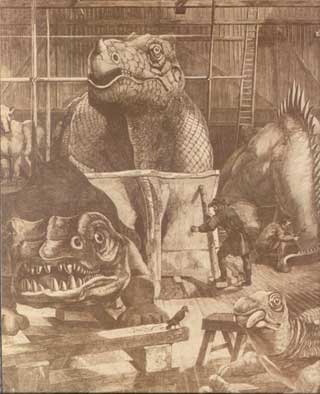
First and foremost I need to point the phenomenal author and illustrator’s notes located in the back of the book. Please read these! They offer so much insight into the history surrounding the book and the creative process it took to create the book. Also be sure to point out exactly how Waterhouse created his dinosaurs. It's fascinating and laid out very clearly in the book! Just look for the page that looks like this:


I cannot even begin to list all the creative ways in which you could use this book. I would definitely have this book available for any biography assignments or projects. You should also use this book anytime that you are talking about dinosaurs. You could also incorporate it into a history lesson on England and Queen Victoria. A great idea would be to let your children write what it would have been like to live back in a time when dinosaurs basically did not exist. This thought process could lead to some very creative journal entries. Here is another great teaching idea that I found online: http://www.readwritethink.org/calendar/calendar_day.asp?id=254.